

Surviving Feature Assimilation
Building Defensible AI Applications


While the foundational model layer has been scrambling to attract talent by paying a gazillion dollars to the key talent, the real business opportunity for most founders and operators isn’t in competing at that layer—it’s in the application layer, where those capabilities are wrapped into workflows, products, and services that solve specific customer problems.
The Application Layer Opportunity
Applications are where AI becomes useful, sticky, and monetizable. But there’s a trap: the closer your value proposition is to a foundational model’s native capabilities, the more vulnerable you are to feature assimilation—when the model provider releases your product as a built-in feature. This has been the case for a long time now.
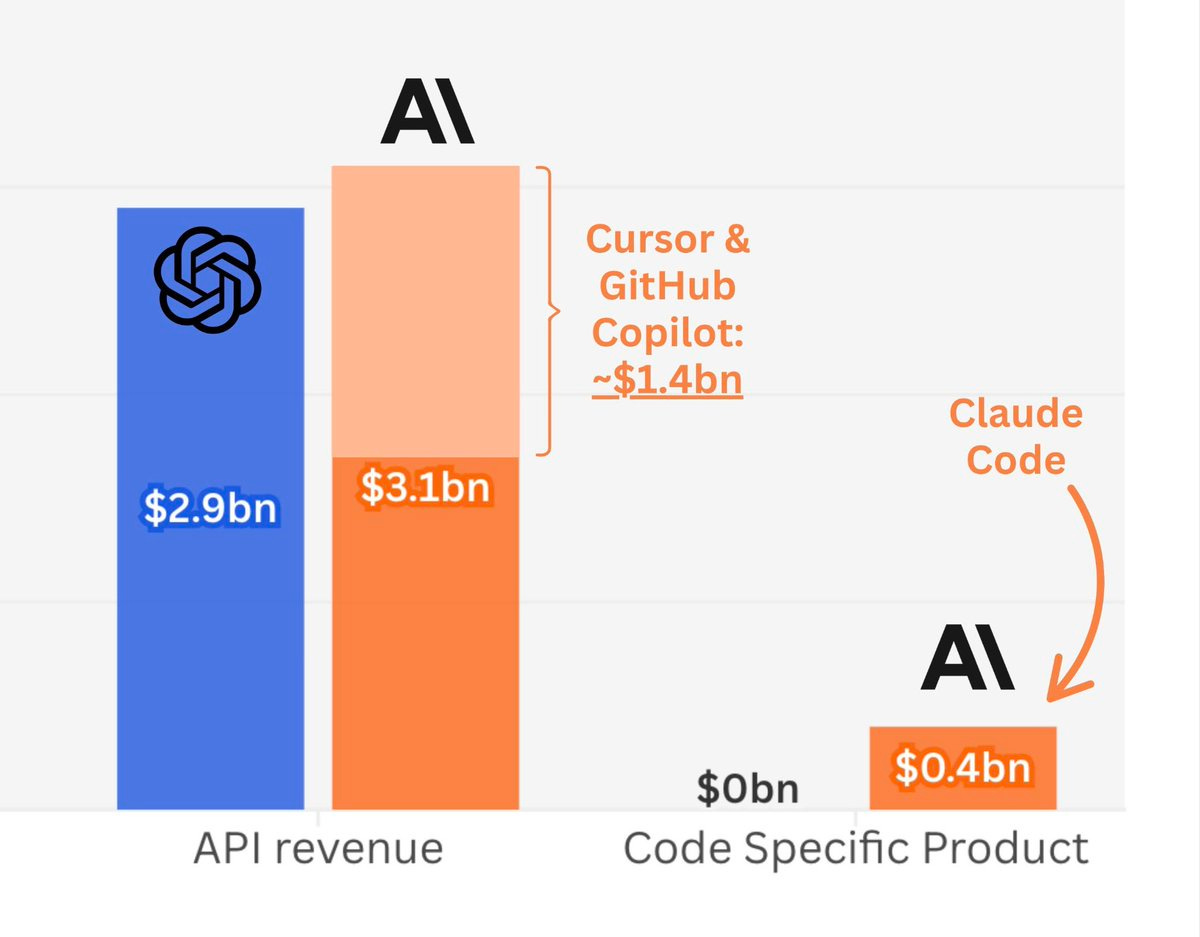
Consider how ChatGPT disrupted the early wave of content startups, such as Jasper, or how Anthropic’s Claude Code is now challenging AI coding tools like Windsurf and Cursor. Features that once seemed like defensible products have quickly become baseline capabilities. Cursor, for example, reached a $500M revenue run rate this Jun within a year of launch. Since launching Claude Code (in May 2025), Anthropic’s ARR from Claude Code has already hit $400M, doubling within just a few weeks.
Sidebar - This is a Distribution Advantage as explained by Hemant Mohapatra: when distribution is proprietary, distribution wins (Comcast vs. Netflix); when distribution is commoditized, the best product wins (Chrome vs. IE); when a product is commoditized, the best service wins (Amazon vs. others); when service is commoditized, the best network wins.
The key question becomes - How do you pick application-layer bets with strong product-market fit and build moats so the models don’t eat you alive? This has been a key question since the start of the evolution, one in which we have seen the optimal use case evolve. Not every AI use case is born equal. Some have an obvious and immediate PMF; others require ecosystem maturity or workflow redesign before they take off.
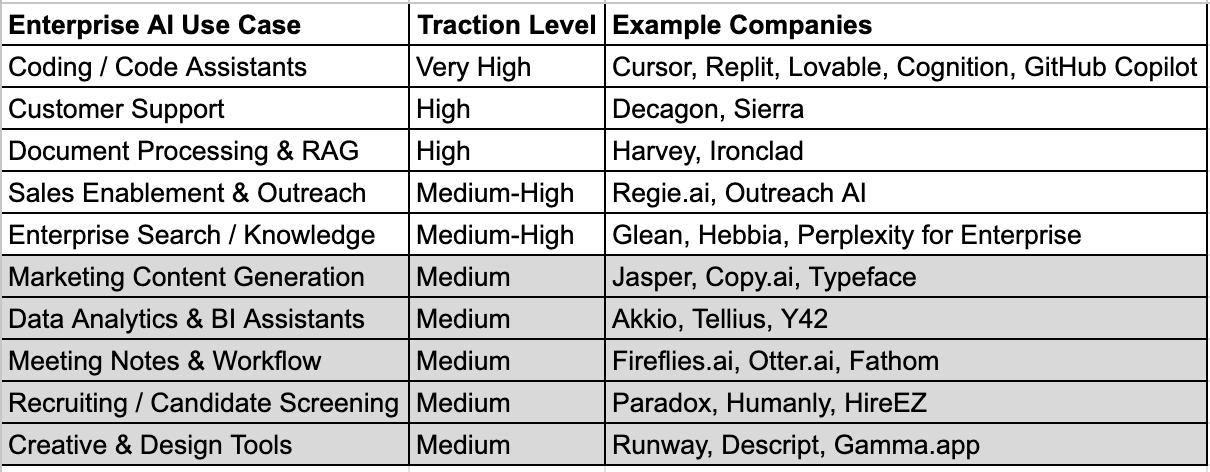
Below are some examples showing enterprise AI use cases, the level of traction, and companies winning in each segment.
Winning in the Application Layer
The coding space is a clear example of a category with both rapid adoption and intense competition. Cursor, Replit, Lovable, and Cognition are pushing towards full-stack AI development environments, but face existential risk as model providers ship "Claude Code" or "GPT Dev Mode" that directly competes.
To win, application-layer products must:
Specialize deeply (vertical depth, compliance, integrations, domain-specific workflows) - this is key.
Own distribution (developer community, enterprise channel partnerships, and network effects), as seen with Anthropic above, which achieved $400M ARR in weeks for Claude Code, thanks to its existing distribution. This is what made Teams overtake Slack overnight: the power of distribution.
Leverage proprietary data (fine-tuning or RAG on customer data).
Create switching costs (embedding in workflows, offering SDKs/APIs, storing valuable in-app state). Similar to Cursor's visual interface and seamless integration with VS Code, which makes it appealing to those who prefer a traditional IDE workflow over Claude Code. Or the cost effectiveness of Cursor at ~$20/month compared to the $200/month for Claude.
For a more detailed write-up on specializing deeply and building service-as-software startups, read this well-researched post by Ashu Garg.
The application layer in AI is a high-velocity game. You can’t count on being the best model—you have to be the best at turning models into indispensable business outcomes. And tie your success to those business outcomes, more on that in the following article.